Phase 1: SEND
Get your business cited by AI search — not just ranked.
The short answer: AI engines like ChatGPT and Google AI Overviews cite businesses that have a complete, structured, consistent entity footprint across the web. The SEND phase builds that foundation — so when a buyer asks AI for the best local contractor, your name is in the answer.
The difference
Traditional SEO vs. GEO / AEO
| Aspect | Traditional SEO | GEO / AEO |
|---|---|---|
| Target | Search result position | AI-generated answer citation |
| Primary signal | Keywords + backlinks | Entity authority + structured data |
| User action needed | User clicks a search result | AI names your business in the answer |
| Durability | Vulnerable to algorithm updates | Based on entity trust — more stable |
| Citation source | Your own content ranking | 65–93% third-party / earned citations |
| Best for | High-volume informational queries | Local "who is the best X near me" queries |
Why it works
What the SEND phase builds
Entity foundation
Consistent NAP (name, address/service area, phone) across every authoritative directory and data aggregator. The base layer AI systems read to identify your business.
Schema markup
Organization, LocalBusiness, FAQPage, and Service structured data that gives AI engines machine-readable facts about who you are, what you do, and where you serve.
Passage-level answer content
Pages built with ≤300-character direct answer blocks at the top of every key section — the format AI systems extract verbatim when assembling citations.
sameAs connections
Verified cross-links between your website, Google Business Profile, social profiles, and third-party citations that signal entity coherence to AI crawlers.
FAQ markup
FAQPage JSON-LD with answers rendered in static HTML — readable by AI bots without JavaScript execution. Five to seven questions per page, each answer under 300 characters.
Citation seeding
Placement in authoritative local and vertical directories that AI engines use as third-party signals — the sources cited 65–93% of the time in AI-generated answers.
Live proof
ChatGPT names a client — without being asked to.
Cornerstone Services, Inc. (a direct mail client) is cited by ChatGPT as the top result for "direct mail company, Hudson Valley, New York" — unprompted, with no paid placement.
This is third-party, verifiable AI citation — the result of entity foundation work, not rankings or ads.
Read the full case study →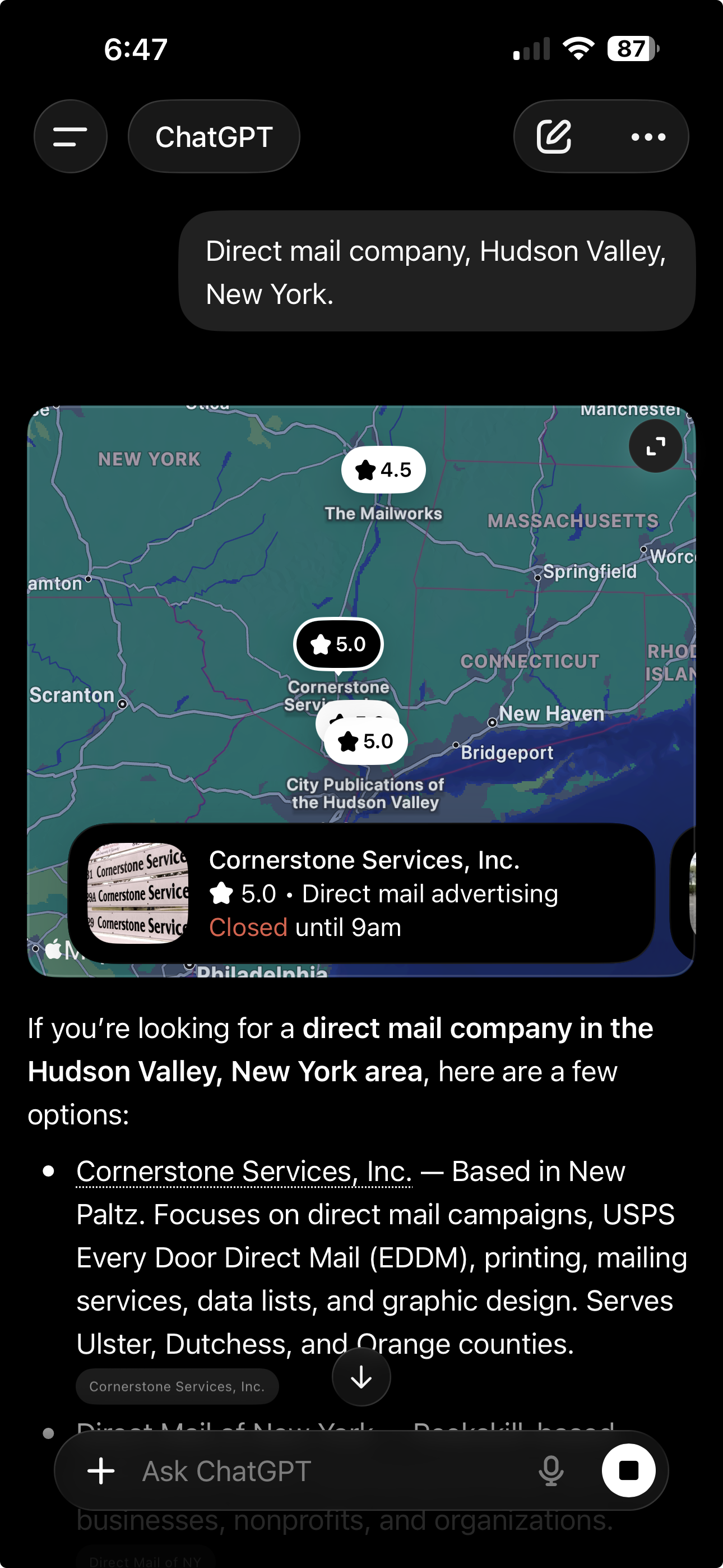
FAQs
Common questions about GEO & AI citation
What is GEO (Generative Engine Optimization)?
GEO is the practice of structuring a business's entity data, schema markup, and content so AI systems like ChatGPT, Google AI Overviews, and Gemini select it when generating answers. Unlike traditional SEO targeting ranked URLs, GEO targets AI-generated responses.
What is AEO (Answer Engine Optimization)?
AEO optimizes content to be extracted and cited by AI answer engines — the tools people use instead of clicking search results. A business that appears in AI answers gains visibility without requiring a user to visit a search results page at all.
How is GEO different from traditional local SEO?
Traditional SEO wins ranked positions in a list. GEO wins named citations inside AI-generated answers. Both matter, but AI citations are more durable — they're based on entity authority, not keyword density or backlink counts.
How long does it take to get cited by AI?
Entity foundation work typically shows AI citation signals within 60–120 days, depending on the business's existing online footprint, competition, and the quality of the entity data. Third-party citations (directory listings, press, client mentions) accelerate this.
Can any local business get cited by ChatGPT or Google AI Overviews?
Yes — local service businesses are a primary target for AI citation because users frequently ask AI tools for local recommendations. The businesses with complete, consistent, structured entity data across the web win those citations.
What do you actually build for the SEND phase?
Entity foundation (NAP consistency, schema markup, sameAs connections), AI-extractable content pages with passage-level answer blocks, structured FAQ markup, and citation seeding across authoritative directories and third-party sources.